Sunday, 21 November 2010

OCA Course: Assignment 1: Contrasts - images


For the main text for this assignment refer to the previous post.


Rural/Industrial Contrast: Ferrybridge Power Station and Fairburn Ings RSPB Reserve.


Solid/Liquid.


Sweet/Sour.


Small/Large.


Low/High.


Few/Many.


Narrow/Wide.


Blunt/Sharp.


White/Black.

Thursday, 4 November 2010

OCA Course: Colour - Primary and secondary colours.


Primary and Secondary Colours: As I live in a very rural area, most of the colours I see relate to vegetation rather than man-made structures, so these images are local to the surrounding countryside, village or garden. Despite it being near the end of the flowering period, there was still plenty of early autumn colour. I cheated with the exposure variations in this series, as I modified the exposure "in computer", using Adobe Lightroom to vary the camera exposure by half a stop either way. I don't think the end result is much different.

1. Violet: Cyclamen. EOS 10D, 150mm macro lens, tripod.
Underexposed half a stop. (Despite owning newer DSLR's, I still like the 10D. It produces nice colour from it's 6 megapixel sensor because the photosites are relatively large - images are OK up to A3).

2. Correct exposure.

3. Overexposed half a stop.


4. Blue: Meadow Cranesbill: Canon S90 compact digital in macro mode. Underexposed half a stop. The increased saturation helps here.


5. Correct exposure.


6. Over-exposed half a stop. A bit washed-out.


7. Green: Convolvulus - yes I know the flower is white, but the leaves are green. and show some nice lines in the composition. Underexposed half a stop. Detail in the flower is better. EOS 1D Mk111 with 50mm macro lens.

8. Correct exposure.

9. Half a stop over- the flower is burning out.


10. Yellow: Rowan berries (yellow strain)- underexposed half a stop. EOS 10D, 150mm macro lens.


11. Correct exposure.


12. Half a stop overexposure - Perhaps enhances the succulent appearance of the berries.


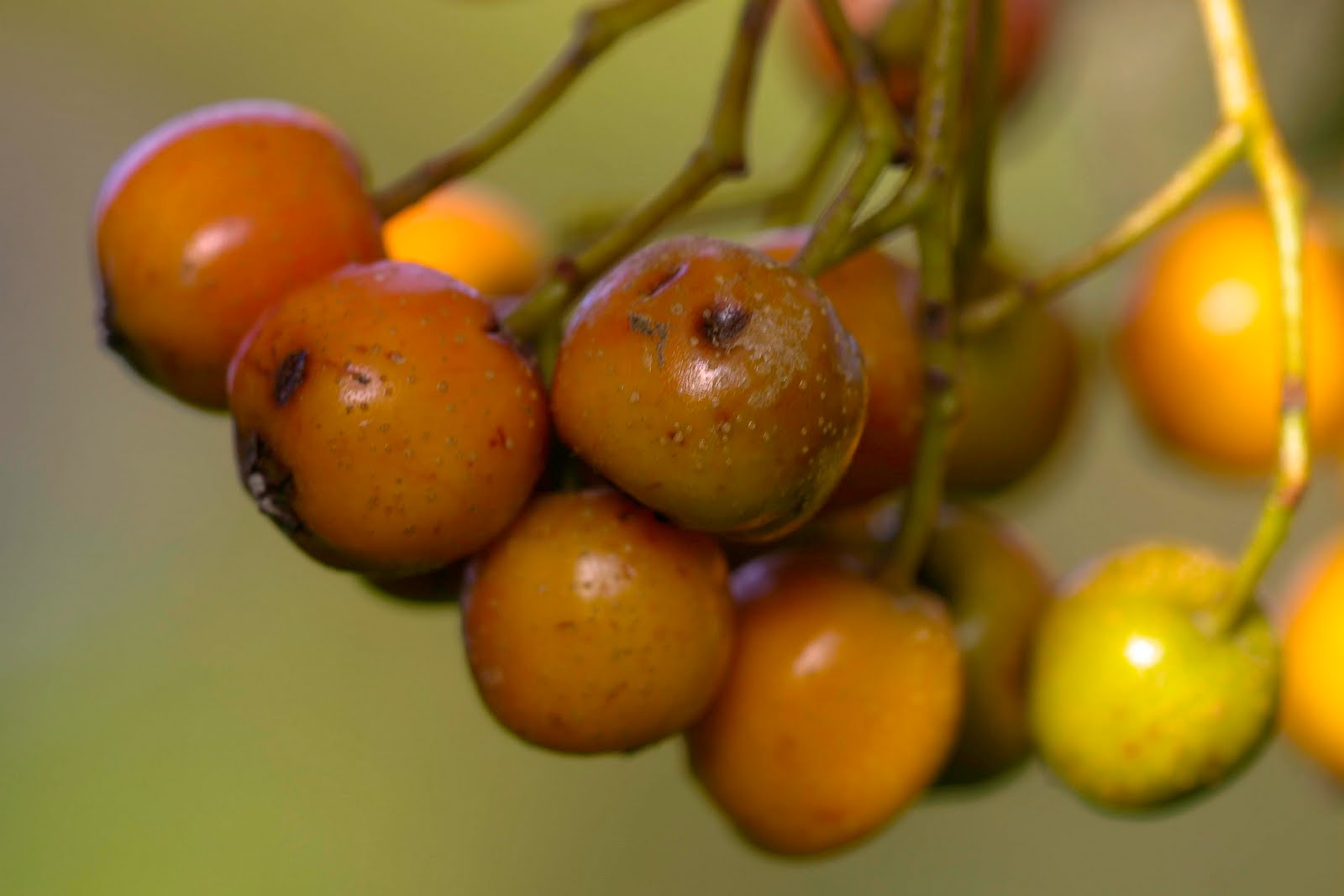
13. Orange: Whitebeam berries - underexposed half a stop. Probably a bit dull. EOS 10D, 150mm macro lens.


14. Correct exposure.


15. Half a stop over exposure - the orange is more prominent.


16. Red: Virginia Creeper. This house in the village is covered in it (see previous posts). EOS 1D Mk111, 17-40mm zoom @ 17mm. Underexposure by half a stop renders the red too dark, probably because of additional underexposure caused by the bright sky.


17. Correct exposure, but still a little too dark.


18. Overexposure by half a stop - produces a correct rendition of the red creeper. I should have compensated by a stop or so when taking the shot originally.


Conclusion: There is probably no such thing as correct exposure, and modern digital image processing software programmes allow more experimentation to get a pleasing result without burning up expensive film. From this limited series, it seems slight overexposure benefits the reds, yellows and oranges, but slight underexposure benefits the blues and violets.

OCA Course: Colour - Control the strength of a colour


Control the strength of a colour: This is a stable door in Germany. It was brand new. I used a Canon EOS 1D Mk111 and a 100-400 zoom to image a section of it, and took the required exposures. It was a nice sunny day.

1. One stop overexposure: The colour and metalwork are a little "washed-out".


2. Half a stop overexposed: Acceptable.


3. Correct exposure as per camera meter. Good detail in metalwork, colour accurate.


4. Half a stop underexposed: The green may be a little more saturated, but looks dull to me.


5. One stop underexposed: Dull and dreary.


Conclusion: The correct reading from the camera meter looks best to me, which just goes to show that modern technology is quite good.

OCA Course: Implied Triangles


6. Mammo girls: I got fed up with relatives and friends not wanting their photograph taken so I roped in some of my colleagues from work. It was a rush job (these girls work their socks off, and, like many others, are the backbone of the NHS), so I used a digital compact with built in flash for what is essentially a snapshot. I arranged them around the mammography unit to give the triangle, but didn't account for the flare. Canon S90 on auto.


5. Little boxes 2: Ditto, but the other way up.


4. Little boxes 1: I really hate "flower arranging". My wife collects these trinkets, at least they have some intrinsic interest, but the photograph doesn't! I used an umbrella flash directly overhead to give even illumination. Canon EOS 1D Mk111, 50mm macro lens. Tripod.


3. Moorland sky: Much of the North Yorkshire Moors National Park is heather, with the odd tree thrown in. I was birding up here and this sky presented itself. The cloud formation in combination with a 17mm wide-angle lens gives a triangular perspective with the apex at the bottom. Canon EOS 40D, 17-40mm zoom.


2. Nursery: I live on the edge of the North Yorkshire Moors Forest Park, which is mostly commercial (Forestry Commission) timber production. They grow new trees from seed in these nurseries (about 11 million per year). They use mechanised techniques which result in perfectly straight rows, 5 to a strip. Perspective gives a strong triangle, apex to the top. Canon EOS 1D Mk111, 17-40mm zoom.


1. Shieldaig sunset: My wife and I were on holiday on the west coast of Scotland this summer. It was great apart from the midges, which were vicious. We had just emerged from the local hotel after having a superb meal, to be met by this superb sunset. The rigging of the yachts provide the triangles. Canon EOS 1D Mk 111, 17-40mm zoom.


Implied Triangles: It wasn't too difficult to find subject matter for this exercise, but it did prove difficult to get friends and family to pose. Strange how everyone hates their own photograph, or perhaps it's just me making a poor job of it!
This post may read from bottom to top. The last photo of the bale stack is a dilemma - is the triangle real or implied?

Saturday, 18 September 2010

OCA Course: Rhythm and Pattern.


Pattern: These Virginia Creeper leaves cover most of the side of a house in our village. Their constant repetetive shape, but slightly variable distribution, gives a nice pattern. I used a polarising filted to cut down some of the glare from their shiny surface, and to enhance their redness. EOS 1D Mk111, 17-40mm zoom @23mm. 1/50sec @ F5.6 ISO200.


Rhythm. This is an avenue in a quiet part of Scarborough. The repeated elements of tree and shadow form a rhythmic score along the road. EOS 1D Mk111, 100-400mm zoom @ 320mm (to compress perspective), 1/125sec @ F11, ISO 400.

Friday, 17 September 2010

OCA Course: Implied Lines.


The lines in this image all point to the far end of the stable corridor where the horse and groom are working.


There is a definite eye-line from these two guys, even though it extends to some unknown subject outside the frame.


Here are three of my images with implied lines drawn on copies.


Burton Riggs Nature Reserve.


Male and female Wigeon, and visitors to the Tractor Show (see previous blogs).


Here are my suggestions for implied lines in the images in the OCA course manual. The horse appears to be looking at the trainer, forming an "eye line". There are a number of curves in the bullfight image, the strongest of which is the "s-shaped" curve as indicated with the arrow runnuig from the ground up to the matadors' arm.