Sunday, 5 June 2011

OCA Course: ASSIGNMENT 5


WHAT'S THE POINT-TO-POINT?


A LOOK AT AMATEUR HORSE-RACING
BY IAN GLAVES

 
Have you ever fancied a day at the races, but were put off by the thoughts of high prices at prestige events such as The Grand National or The Derby? And who wants to dress-up like that to paddle around in a wet paddock? There is an alternative that can be just as much fun, where you can have a flutter on the ponies nearer to home than you realize. It's called Point-to-Point Racing, and it's happening all over the country.

The sport of Steeplechasing was originated by hunting men who raced their hunting horses over natural country from point-to-point, usually church steeples as they were the only landmarks that could be seen on the flat. The sport developed during the 19th Century, becoming more sophisticated and run on enclosed courses with thoroughbred horses, professionally trained. This sidelined the amateurs, who couldn't afford to compete at this level.

Local Hunts undertook to organize amateur events with much success, the Worcestershire Hunt started meetings from 1836, with Atherstone claiming to be the first Hunt to stage an annual event from the 1870's.

There have been many changes of rules and administration over the years, but it is now under the control of the British Horseracing Authority. The horses must not be from professional yards, and the jockeys must be amateurs. Women can ride (this wasn't always the case – men only in the early days), but no-one under 16 years is allowed. Prize-money, sponsorship and advertising are recent innovations.

The courses are between 2.5 and 3 miles, with a varying number of jumps made from birch brash. The meetings are open to the public (with suitable admission fee), and there are registered Bookies on site to take your bets. Meetings are mostly organized by local Hunts, and any profits made go to the upkeep of the Hunt and it's hound pack. Despite knock-backs recently with the hunting legislation, Point-to Point meetings continue without any diminution in popularity.

It can be a fun day out for all the family – although most meetings are held on an afternoon on weekends or Bank Holidays. Details of events near you can be viewed on http://www.pointtopoint.co.uk. You need to be aware that under 18's are not allowed to bet.

My local event, only four miles from my home, is run on a course on farmland at Charm Park. There is a flurry of activity in the days preceding the event, with the erection of marquees, enclosures, stalls, and, most importantly, a beer tent!


Charm Park – parade ring and runners and riders board.


The Bookies are early on the scene to be set up before he first race. Wily characters who've been around! "Poverty on Tour"! I don't think so. According to locals, there are two things you never see – a contented farmer and a dead donkey. I'd add a third – a poor Bookie!

The Staintondale Hunt organizes the event, run by a dedicated team to a well-oiled plan. Many of the Hunt members volunteer, and all jumps are manned by stewards, with paramedic cover, with a doctor always on duty for the whole event. You can be sure of a few spills with amateur riders and horses, but serious injuries are rare.

The meeting usually kicks off with a parade of the local Hunt, with the Kennel-master and his hound pack.

 
Despite their hunting instinct, the hounds are friendly.


Pony Club girls will sell you a programme and race-card.


Horses and riders arrive well before the first race, as there are preparations to make.


"Come-on, what are we waiting for?


All the owners want their horses to look their best, so much grooming and beautifying goes on.


Nice buttocks.


Make sure that girth is tight- it's hard enough to stay on over 19 jumps!


It's very important to keep the mount exercised prior to the race. There's a whole bulk of muscle that has to be warmed-up and at peak efficiency before galloping and jumping the 3 mile course, so the stable girls (it always seems to be a girl!) keep the horses walking about until they head for the parade ring. There's still time to text the boyfriend, however.


When horses and riders are called, they head for the parade ring, where jockey and mount meet up, and the public get a chance to assess the form. It's the last chance to choose before putting the bet on. Then you join the queue for your favourite Bookie.


Mounting up.


Pre-race apprehension, perhaps?


Studying form – it's an important decision!


Who's offering the best odds?


Waiting to be called in by the starter.


Off and running.


Second lap and they're still bunched – a close race adds to the excitement.


How to do it! Eyes forward, ears pricked looking for the next jump.


How not to! Loose horses are a danger to other riders and spectators. Despite fences and barriers, this riderless horse ended up in the crowd. Fortunately, no serious injuries resulted.


Going for the line.


Winner!

Three miles over 19 jumps is a grueling race. Many don't complete the course but the jockeys are sensitive to their mounts and will pull them up if they have had enough. Flogging a dead horse won't get you a ride in the next race.


Loser! The wrong horse came first.

However, it's not over until it's over. The jockeys have to "weigh-in" at the end of the race to make sure their handicap weight is the same as at the start. Losing the weights on course will lead to disqualification.


Weighing-in.


To the victorious owner – the spoils.

There are usually 6 or 7 races per meeting, so a full afternoons' entertainment is guaranteed, although the number of entries in the programme doesn't equate with the actual declared runners on the day – some horses may be unfit, or the going not suitable. Occasionally it's a two horse race! Mostly it's exciting and fun, and you might come away with a pocketful of winnings, although I wouldn't bet on it!


OCA Course: Higher and Lower Sensitivity

Higher and lower ISO settings:

1. Horse and rider: taken in an arena in daylight at ISO 100, aperture fully open. The shutter speed isn't fast enough to arrest movement.


2. ISO now bumped up to 1000. Movement arrested, and the technical aspects of the rider and horse can be analysed.


3. Magnified view of image 1. No significant noise.


4. Magnified view of image 2. Significant noise.


O.K. - that's enough of that. I'm a bird photographer and the one thing I learned after losing my milk teeth was the trade off between film speed and grain, blurred images and sharp ones. The one great advance that digital imaging has made is that of sensitivity of the recording medium. The shot below of the rare and enigmatic Red-billed Scimitar Babbler taken in South-west China is a classic example of how digital has freed up bird photography from the constraints of film. The shot was taken in dim conditions of thick jungle by poking a 500mm lens with 1.4 converter through a hole in the undergrowth, hand held, at ISO 3200, F5.6, which still allowed a shutter speed of 1/320 sec., which, combined with image stabilisation, produced an acceptable image. Yes, there is noise, but it's far better than ISO 3200 film grain, even if I'd had any loaded in a film camera. I'd never have got this shot using film.

ANYWAY - it's all becoming irrelevant. ISO settings on digital cameras will soon be a thing of the past. Sony's new 16 million pixel sensor , the IMX071, can produce acceptable images when 6 stops off the correct exposure (when shooting RAW format), so there is no need for "correct" exposure. This sensor is already available in consumer DSLRs. If you want to apply effects of grain or your favourite slide film characteristics, there are plenty of software programmes that can do this for you. So I don't propose to wander the streets of Scarborough at twilight to prove a largely irrelevant point, and I don't find blurry or noisy pictures "artistic".

Friday, 27 May 2011

OCA Course: Cloudy Weather and Rain.

Sunny/Cloudy:
1. Scarborough castle in evening sun. 1/1500sec @F8 ISO 400.

2. Scarborough castle in cloud. 1/1000sec @F8 ISO 400.

Although it's only half a stop difference, the cloudy picture is underexposed by at least another stop.


3. Diving Belle in low afternoon sun. 1/250sec @F8 ISO 200.

4. Diving Belle in cloud. 1/80sec @F8 ISO 200.

The low sun accentuates the difference between the yellow and blue images. About a stop and a half difference.


Here are two of my images that are improved by light cloud or haze. Too much contrast from full sun would lose some of the subtle tonal differences in the plumage of these two birds - this may be important for identification of some species, such as warblers, which have very similar green/brown plumage.

1. Short-eared Owl (it will win the staring world championships).

2. Juvenile Iceland Gull (subtle plumage differences can help to age the bird).


Three pictures in overcast conditions:

1. Camelia.

2. White flower (don't ask!). White things with detail come out better in hazy or cloudy conditions.

3. Dryads saddle. This was in a wooded glen, and detail in the deeper parts would be lost in full sun.


Rain: It hasn't rained for almost three months in North-east Yorkshire and the farmers are desperate. It wrecked my schedule for this exercise, but a short shower yesterday brought relief. 

1. Rainbow: This was taken last year on a digital compact. It's interesting how the sky darkens between the inner and outer bows due to its refraction.

2. Car window and mirror: many years ago i used to visit the Impressions gallery in York, when they had a good exhibition on. I recall some very interesting images from a young lady (oriental, I think) who was driving around town at night in a beat-up 4x4 taking urban images through a rain spotted car window. Some were memorable. Here are two of mine that aren't. The car window also needs cleaning. They were also taken on a digital compact.

1. With mirror.
2. With rosebush.

OCA Course: Tungsten and Fluorescent Lighting

Tungsten: Sitting room and patio. At ISO 100 the light levels in the room and outside gave an exposure of 0.4sec @F4, so no hand holding.


                                          1. White balance on Auto.


                                          2. White balance on Daylight.


                                          3. White balance on Tungsten.

The difference between auto and daylight WB is minimal, as the auto setting does a good job of equating the scene to daylight at the expense of very yellow tungsten lighting. On the tungsten setting, the room looks relatively normal, but outside is cold and blue.


Fluorescent: Utility room and window. Again, at ISO 100, 0.8sec @F4 meant a tripod was essential. 


                                          1. White balance on Auto.


                                          2. White balance on Fluorescent.

The auto setting gives some warmth, but is too yellow. The fluoro setting is nearer the correct appearance but looks a bit grungy, and isn't a true match. Perhaps it is a bit green.


O.K. - that's quite enough of white balance. I don't use small fluorescent bulbs on principle because of the pollution caused by those countries who mine the chemicals to make them - just like batteries for electric cars, so I'm not doing any more images for this exercise. Long live petrolheads.

My God, that was a boring exercise!

Thursday, 19 May 2011

OCA Course: Narrative: A Picture Essay.

DRESSAGE LESSON
All riders of any discipline and of whatever standard need training to get the best results. Horses don't work straight out of the box! They need preparation, patience and practise.

Meet Eddy


An intelligent dressage horse


Out of the box


First pick out the hooves -


 - and oil them


A good grooming


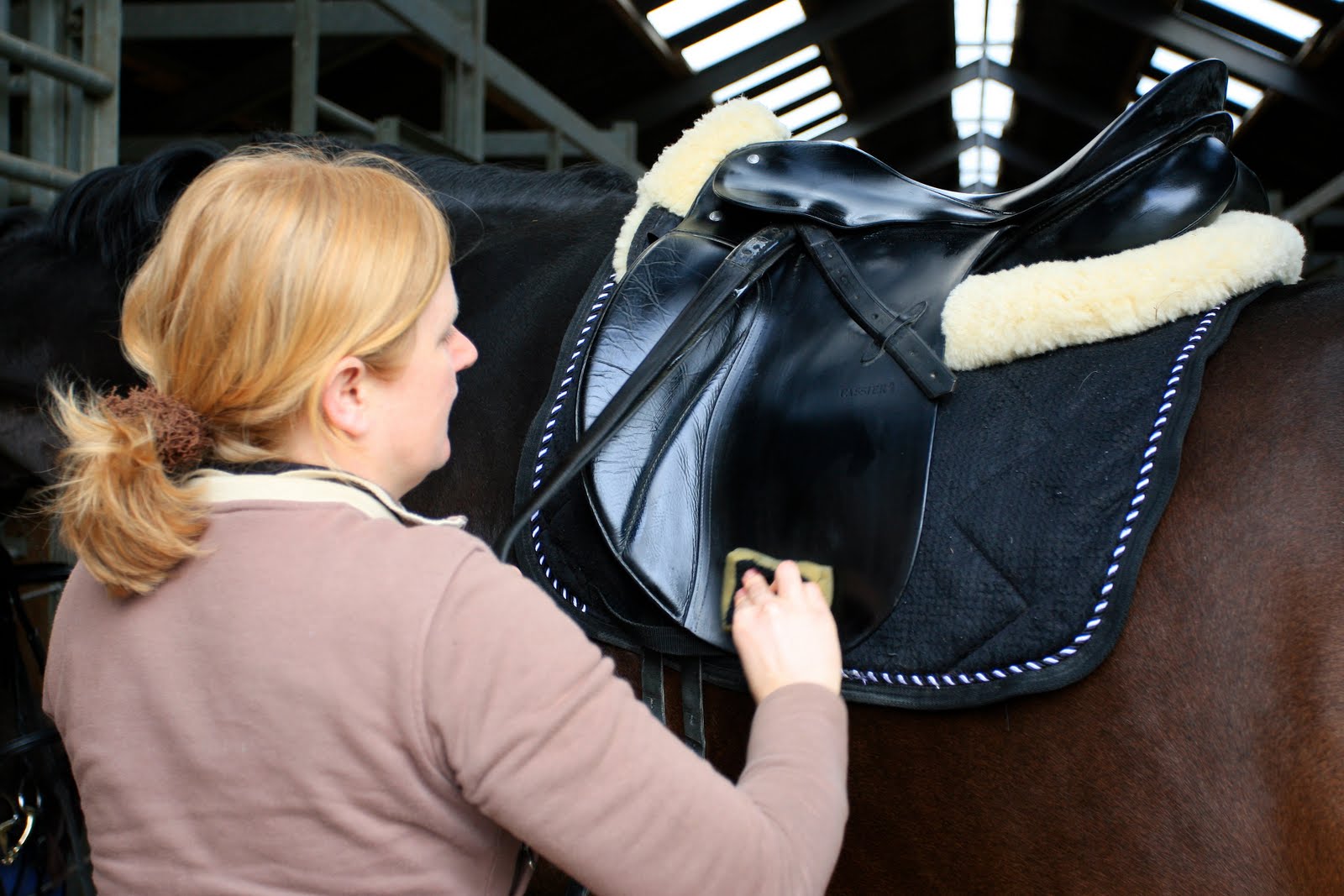
Polish that saddle


 Final adjustments


Don't forget the rider


 Off to the arena


Mount up


Meet the trainer


Assessment


Like this


 Got it!


 Going well


The grooming images were taken with a wide-angle zoom, and the arena pictures with a tele-zoom so as not to spook horse and rider whilst concentrating. ISO 800-1000 to stop motion in a dark arena.